|
The UN Conference on Sustainable Development (UNCSD) popularly known as Rio+20 to be held in Brazil during June 2012 which aims:
- To ensure a renewed political commitment to sustainable development;
- To assess the progress made in implementing the Agenda21, WSSD Plan of Action; MDGs and MEAs relating to Sustainable Development (SD); and
- To address new and emerging challenges to achieve SD
The official discussion of the Rio+20 will focus on two main themes:
- how to build green economy to sustain development and
- how to lift people out of poverty and how to improve international coordination and cooperation for achieving SD
The leaders of the governments along with experts and scientists, Private sector, NGOs and civil society representatives will discuss approaches and urgent steps towards reducing poverty, advancing social equity and justice, protecting human rights, creation and distribution of wealth and income, ensure access of the poor to common goods and services, information and technologies for greening the economy as well as ensure environmental protection for the present and future world.
Poverty Eradication: The poverty ration has decreased globally, but the absolute number of poor people is increasing in many developing countries. The devastating impacts of global climate change are also aggravating poverty situation, food, water, health, livelihood and social securities of the millions. Today, the world has:
- Over 7 billion people
- One out of every five people (which is over 1.4 billion) lives in poverty
- A billion and a half people don’t have access to safe drinking water; and
- One billion people go hungry every day
Majority of the poor and extremely poor people live in Africa and South
Asia. A secured and sustainable world cannot be envisioned without eradication of poverty. During the first Rio Summit in 1992, the Global
Forum on Environment and Poverty (GEFP) demanded and articulated a Poverty Convention and highlighted, “There is no Sustainable Development without Alleviation of Poverty.” This was partially reflected in the subsequent WSSD Plan of Action and UN‐MDGs.
Green Economy: The world is facing a severe economic crisis in the recent years. The concept of Green Economy has been developed to address the economic crisis of the west as well as to promote SD with the three guiding principles:
- Ensuring human wellbeing
- Economic growth with equity and justice and
- Reducing environmental degradation and risks
Hence, the current development path has to be redefined to address the challenges of green economy and poverty eradication. The economic growth, income and employment in pursuing green economy should be driven by public and private investments that
- reduce pollution and carbon emission,
- enhance energy and resources efficiency and
- prevent the loss of ecosystems and biodiversity
The new development pathway must maintain, ensure and where necessary should rebuild natural capitals as well as critical economic assets and resources for public benefits, especially for poor people whose livelihoods and security largely depend on natural resources and ecosystem services.
The Northern industrialized countries have resources, scientific capacity and technologies to advance green economy while the developing countries would need both resources and technologies to pursue green economy and SD. The most essential task of many of the developing countries is to eradicate poverty, accelerate economic growth and then pursue the path of green economy to participate in the global journey of SD, which necessitates greater concerted efforts by all actors and effective global partnership. Hence, a North‐South and South‐South dialogue is essential.
The Objective of the Dialogue is to facilitate the exchange of views and insight of all key actors and stakeholders towards green economy, poverty alleviation and future of sustainable development to influence the Rio+20 process and decisions.
Panel Discussants:
• Dr Ashok Khosla, Chairman, Development Alternatives, India, Civil Society Coordinator of Rio 1992; President of IUCN and Chairman, Club of Rome
• Dr Atiq Rahman, Executive Director, Bangladesh Centre for Advanced Studies, Bangladesh; Coordinator, Global Forumon Environment and Poverty (GFEP)
• Prof. Paul Van Gardingen, Director, Ecosystem Services for Poverty Alleviation Programme (ESPA), London, UK
• Febio Feldman, Former Minister of Environment, Brazil and Main Organizer of Rio 1992
• Andy Parker, Senior Policy Adviser, The Royal Society, London, UK
• Dr. Eliya M Zulu, ACTS, Kenya
• Sanjay Vashist, Coordinator, Climate Action South Asia.
Key Outcomes:
• Exchange stakeholders views on the key elements towards green economy, poverty eradication and sustainable development
• High level Panel Discussion to draw a set of recommendations to influence mainstream discussion and decision relating to poverty eradication and green economy; and
• Develop and continue a multi‐stakeholder dialogue process
|



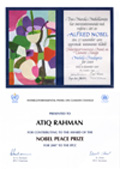 Nobel Peace Prize in 2007
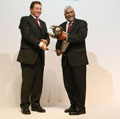 Champions of Earth
 Paribesh Padak